
Employee Recognition Scratch Off Cards
Employee recognition scratch off cards give HR a physical reward moment instead of another email. Formats, reward tiers, print specs, minimums, and pricing.
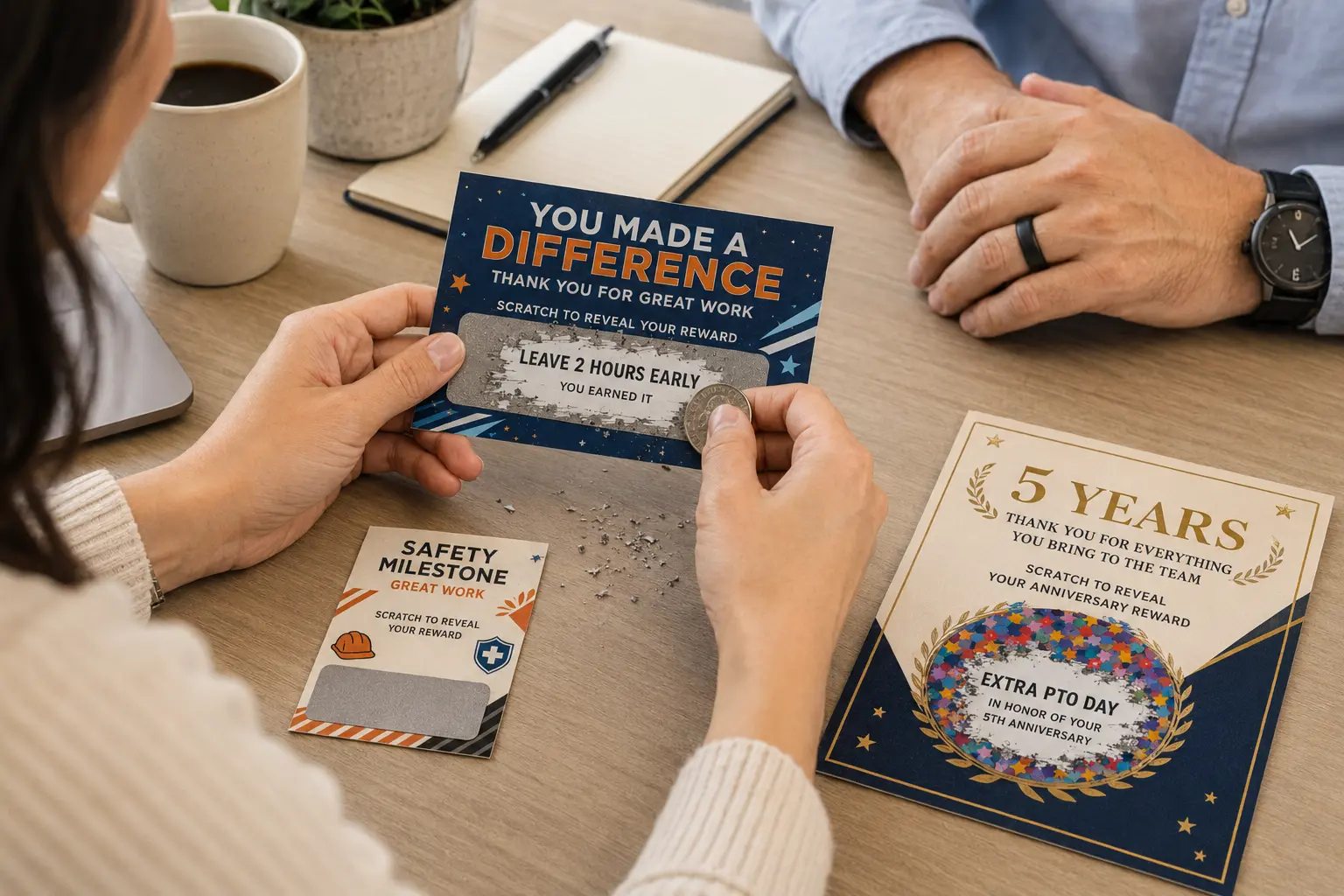
Why does a physical card outperform a digital reward?
Because of timing and witness. The reveal happens in the room, at the moment the manager says why. That makes recognition visible to the team, which is the part that actually changes behavior, and it removes the awkward lag between "great work" and a reward that lands three days later in a payroll email.
What size card should HR order?
The 2.75" x 4" small classic card is the everyday choice: it fits a badge pocket, a break-room mailbox, or a card envelope, and it holds a headline, a reward legend, and a signature line. For a service anniversary or a top-tier award, the 4" x 6" medium full-color card reads like a keepsake. For high-frequency shift incentives, the 2" x 3.5" mini classic keeps the cost per card lowest.
What should the reward tiers be?
Fund the common tier well. Most cards will land there, and that tier is what defines the program in employees' minds:
| Tier | Example |
|---|---|
| Headline, rare | Extra paid day off, premium item, top parking spot for a month |
| Mid, occasional | Gift card you fund, branded jacket, lunch on the company |
| Common, frequent | Coffee card, snack credit, early-out pass, catered team lunch entry |
Print the full legend on the back so nobody has to ask what the tiers are, and set a redemption process that a shift supervisor can run without HR approval.
Where do these programs get used most?
- Safety milestone recognition on plant floors and job sites
- Service anniversaries, often with a full-color reveal keepsake
- Shift or quota incentives in retail, warehousing, and call centers
- Peer-nominated spot awards, where managers keep a small stack on hand
Can employees buy cards or enter a paid drawing?
No. No one may buy a scratch off card or pay for a chance at a prize, since that would make it a lottery. Recognition cards are given, never sold. If your team wants to raise money for a cause, the compliant model is scratch and donate, which is described on the nonprofits and fundraisers page.
What about tax and policy language?
Employer rewards can carry tax and payroll implications depending on what you give and where you operate, so your HR, payroll, and legal teams should set the policy language before printing. You supply the disclaimer and reward-legend copy, and we print exactly what you approve. We do not draft policy or tax language.
Classic silver or a full-color reveal?
Classic silver or gold is the practical default for frequent recognition: clean, familiar, and the cheapest way to run a program month after month. Use a full-color reveal for milestone awards where the payoff should look like a certificate rather than a coupon, and plan on paying more than the equivalent Classic card.
What stock and finishing options apply?
Standard 12pt C2S handles daily use. For service-anniversary cards meant to be kept, 14pt and 16pt feel substantially more premium, and foil and metallic accents suit years-of-service designs. When you do not want a reward readable through the back of the card, ask about the 280gsm blue-core security stock on the cardstock weights page.
What does a recognition program cost to print?
At 250 cards, the smallest online order, small classic starts at $450, about $1.80 each, and mini classic starts at $387.50, about $1.55 each. Programs printing thousands of cards a year land in much lower tiers, down toward $0.08 per card on high-volume mini runs. There are no setup fees on standard orders, in-house layout is included, and a quote comes back within one business day. Current tiers are on the pricing page.
How many cards should a program order at once?
Estimate cards per month, then buy a year at once if your reward tiers are stable. A single annual run keeps the design consistent across locations and drops the per-card cost meaningfully compared with quarterly reorders. If tiers change seasonally, print the tier legend as a separate insert and keep the card itself evergreen.
How long does production take?
Standard production is 7 to 10 business days after proof approval, with 3 to 5 day rush available when the press schedule allows. Digital proofs are free and usually same-day. For a program launching alongside a fiscal year or a safety campaign, order four to six weeks ahead so managers can be trained before the cards arrive.
Related guides
Share your artwork or use our Design-It-Yourself tools. We proof every job before printing. Orders ship in 7-10 business days.