
Scratch Card Fundraising Ideas for Schools, Sports Teams and Nonprofits
How scratch card fundraisers work for schools, sports teams, booster clubs and nonprofits: card design, goal planning, timelines and collecting donations.
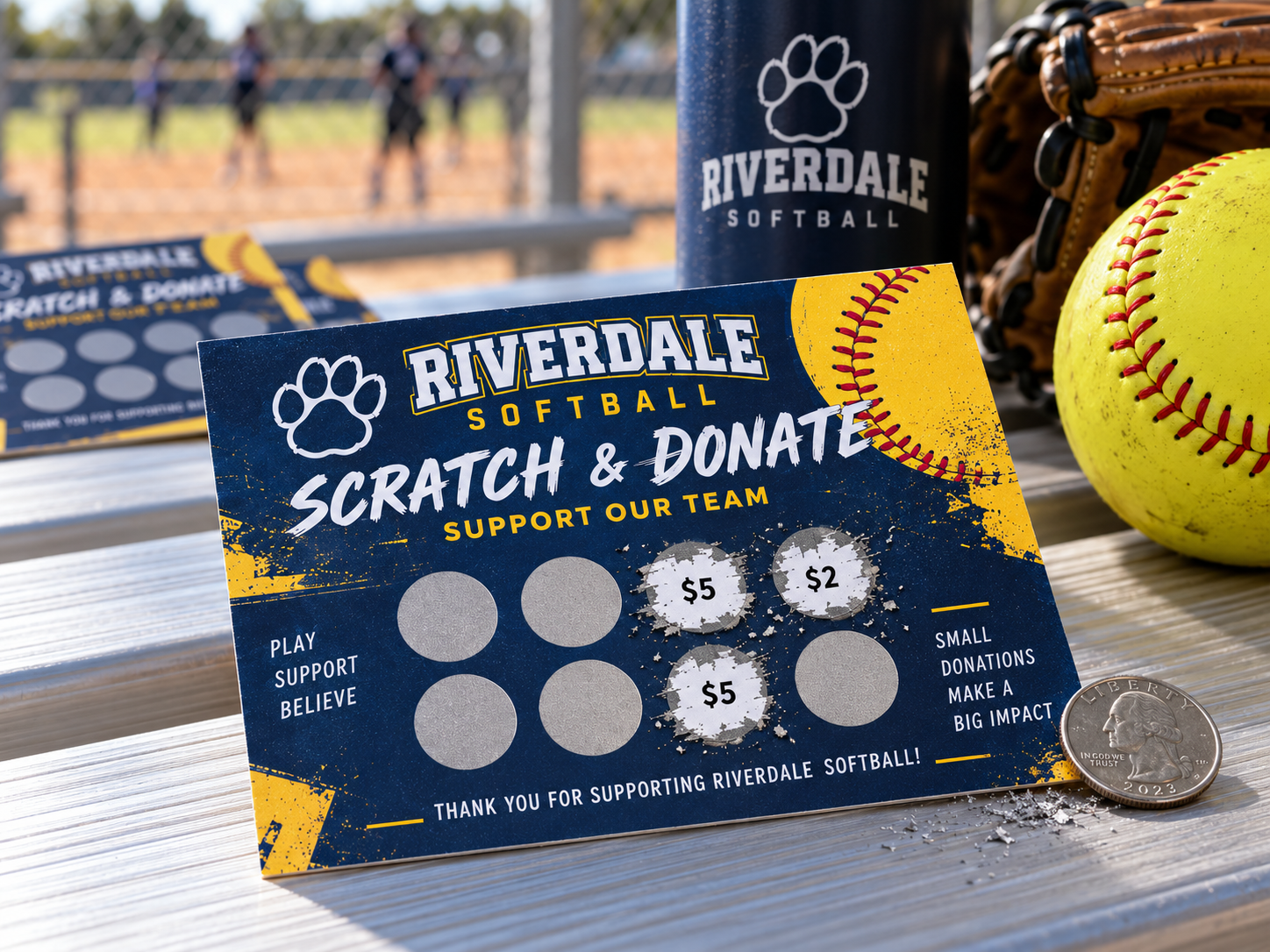
A scratch card fundraiser is a campaign where volunteers hand out free printed cards covered in small scratch-off areas, and each area hides a suggested donation amount. A supporter scratches one or more spots, gives the amount revealed, and the volunteer collects the gift. Nobody buys the card and nobody pays for a chance at anything: the card is an invitation to donate, which is why the format is often called scratch and donate.
How does a scratch card fundraiser work, step by step?
A scratch card fundraiser runs in five steps: design the card, print it, hand it to volunteers, let supporters scratch and donate, then collect and count. The card does the asking, so volunteers spend less time explaining the cause and more time collecting.
- Set the goal and the card count. Decide how much you need and how many volunteers will carry cards.
- Design the reveal grid. Choose how many scratch-off areas the card has and what amount sits under each one.
- Print and proof. Approve a digital proof, then the cards print and ship to you.
- Distribute. Each volunteer gets cards and a return date.
- Collect, record and thank. Volunteers turn in the cards and the money, and the organizer records each gift and thanks donors and sponsors.
A reveal grid is the layout of scratch-off areas on the card. Each area is a small printed amount covered by a scratch layer, the opaque silver or gold coating a supporter removes with a coin or fingernail.
Why do scratch cards beat product fundraisers?
Scratch cards beat product fundraisers because almost nothing is deducted before the money reaches the cause. A candy bar or discount book carries product cost, shipping and spoilage. A printed card carries print cost only.
- No inventory to store, count or return at the end of the campaign.
- No delivery weekend where volunteers drive boxes across town.
- Small asks add up, because a small reveal feels easy to say yes to.
- The card carries your logo, your sponsors and a QR code to your donation page.
What goes on a fundraiser scratch card?
A fundraiser scratch card needs six things: your organization's name and logo, the cause, the reveal grid, donation instructions, a line to record the donor's name, and space for sponsors. Everything else is optional.
- Name, logo and cause. Say exactly what the money pays for, such as band uniforms, new jerseys or a mission trip.
- The reveal grid. Most cards use small amounts, often $1 to $5 per area, so every scratch feels easy to say yes to. Mix the amounts so most are small and a few are larger.
- Donation instructions. Tell supporters to scratch one or more areas and give the amount shown, in cash or online.
- A QR code. Link to your online donation page so supporters without cash can still give.
- A donor line. A small name or initials space next to each area helps volunteers track who gave.
- Sponsor space. Local businesses can appear on the front or back in exchange for a gift to the campaign.
- A "donation only" statement. Make it plain that the card is free and every gift is voluntary.
Your organization writes its own disclaimer, donation wording and any prize legend. Mr. Scratch Off prints exactly what you approve on the proof and does not write legal or compliance copy, so check your wording with your own advisors and your state's rules before you send artwork.
How do you set a fundraising goal?
What a scratch card fundraiser raises comes down to three numbers you control: how many cards go out, how many come back with a gift, and the average gift per returned card. Estimate each one conservatively, multiply them, and you have a planning figure.
- Add up every amount on the grid to see what a fully scratched card would bring in.
- Supporters rarely scratch every area, so plan on a lower average per returned card, then check it against your own past campaigns.
- Multiply cards returned by that average, then subtract the print cost to see the net.
Design the reveal grid to land near the per-card average you want, then work backward to your goal.
Sports teams and booster clubs
Scratch and donate cards suit sports programs because the ask is small, the moment is fun, and every player can carry a stack in a backpack. A softball program, a travel soccer club or a high school booster group runs the same five steps, with a few team-specific habits that make the difference.
Which card size works best for a team?
- Mini and Small cards suit a handout at a game gate or a team pasta night.
- The Medium Classic Scratch-Off Card is the workhorse for team fundraising, with room for a 20-plus area grid and a sponsor bar.
- Large and custom sizes suit booster clubs that want a full sponsor wall on the back.
Which scratch color should a team choose?
Classic silver or gold is the default for team fundraising because it costs less than full color at every size and quantity and reads instantly as a scratch-off. Classic silver latex ink hides amounts completely and scratches clean with a coin. A full-color reveal is worth it when the reveal area itself needs team colors or a mascot printed on top.
What does a season campaign calendar look like?
Work backward from your first home game so the fundraiser does not turn into a two-week scramble.
- Eight weeks out: set the goal, pick the size and gather sponsor logos.
- Six weeks out: submit artwork and approve the free digital proof, usually returned the same day.
- Four weeks out: cards are printed and in hand on the standard 7-10 business day turnaround.
- Opening week: distribute cards at the parent meeting with a completion deadline.
- Two weeks after distribution: collect, count and publicly thank sponsors.
How should players and families distribute the cards?
Distribution beats design every time. A beautiful card in a glove compartment raises nothing.
- Hand cards out in person at a mandatory parent or player meeting, never by mail drop.
- Give every player a personal goal, such as one completed card each.
- Set a hard return date and say it twice.
- Ask each family to approach neighbors, coworkers and extended family rather than the same group of team parents.
Booster clubs that also run a spring golf outing can reuse the same artwork approach described in the golf tournament scratch and donate guide.
How do schools, churches and nonprofits use them?
The format is the same for every group; only the cause and the distribution plan change.
- Schools and PTAs pair cards with a grade-level competition, a spirit-week deadline and a public progress chart. See how schools and PTAs use custom cards.
- Churches use cards for mission trips, youth programs and building funds. See churches and religious organizations.
- Nonprofits hand cards out at galas, walks and community events. See the nonprofits and fundraisers page.
How much do fundraiser scratch cards cost to print?
Print cost depends on size, quantity, stock and whether the reveal is classic or full color, and the price per card falls as the quantity climbs. That is why a club-wide or school-wide run usually nets a better percentage than a single-team run. There are no setup fees on standard orders, and if you send your copy, logo and reveal amounts, the in-house team lays out the card at no charge. Get a written price from the instant quote page, usually within one business day.
Which card size and stock should a fundraiser use?
Pick the size by how many scratch-off areas you need. Mr. Scratch Off prints five standard sizes plus custom sizes and die-cut shapes:
- Mini, 2 x 3.5 in: a few areas, good for a gate handout or a thank-you card.
- Small, 2.75 x 4 in: a short grid, easy to carry in a pocket or backpack.
- Medium, 4 x 6 in: the usual choice for a 20-area grid with sponsor space.
- Large, 6 x 9 in: big grids and a full sponsor wall on the back.
- Custom sizes and shapes: a one-time die charge applies to a custom die and is quoted separately.
Standard stock is 12pt C2S, a card stock coated on both sides. Thicker 14pt and 16pt stock and 280gsm blue-core security stock are options, with availability by project. Blue-core stock has a dark inner layer that keeps the amounts from showing through when a card is held up to light. The silver, gold or full-color comparison explains when a full-color reveal is worth it.
How long does it take to get fundraiser cards printed?
Plan on about three weeks from first artwork to cards in hand. Mr. Scratch Off sends a free digital proof, usually the same day, and production takes 7-10 business days after you approve it. Ground shipping from Orlando reaches most of the US in 2-4 business days. If the date moves up, rush production takes 3-5 business days on most jobs for an added fee.
How do you collect and track the donations?
Give every volunteer a numbered envelope with their cards, a tally sheet and a return date, then record each card as it comes back.
- Number the envelopes so you know which volunteer has which cards.
- Ask volunteers to write the donor's name next to each scratched area.
- Offer an online option through the QR code and match online gifts to cards by name.
- Count returned cards and money together, with two people present.
- Thank donors and sponsors publicly once the totals are in.
If your organization is a registered charity, donors may ask for receipts. The IRS explains what a written acknowledgment for a contribution of $250 or more must include. Mr. Scratch Off does not give tax or legal advice, so confirm receipting and any state rules with your own advisors.
What mistakes sink a scratch card fundraiser?
Most failures are operational, not creative.
- Ordering too late. Cards that arrive after the kickoff meeting miss the moment.
- Ordering too few. Families who want a second card should have one.
- No return date. Without a deadline, a three-week campaign turns into three months.
- Small, buried instructions. Supporters need to see how to give at a glance.
- Framing the card as a purchase. The card is free and the donation is voluntary; never describe it as something a supporter buys.
- Forgetting sponsors. Recognize them on the card and in your thank-you posts, or you lose next season's sponsors.
Next steps
Set your goal and card count, pick a size, and start a quote with your reveal amounts.
Share your artwork or use our Design-It-Yourself tools. We proof every job before printing. Orders ship in 7-10 business days.