
Scratch Off Card Design Guide: Artwork Setup and Specs
Set up scratch off card artwork correctly: 0.125 in bleed, safe zones, reveal area placement, prize legend layout, file prep, and free same-day digital proofs.
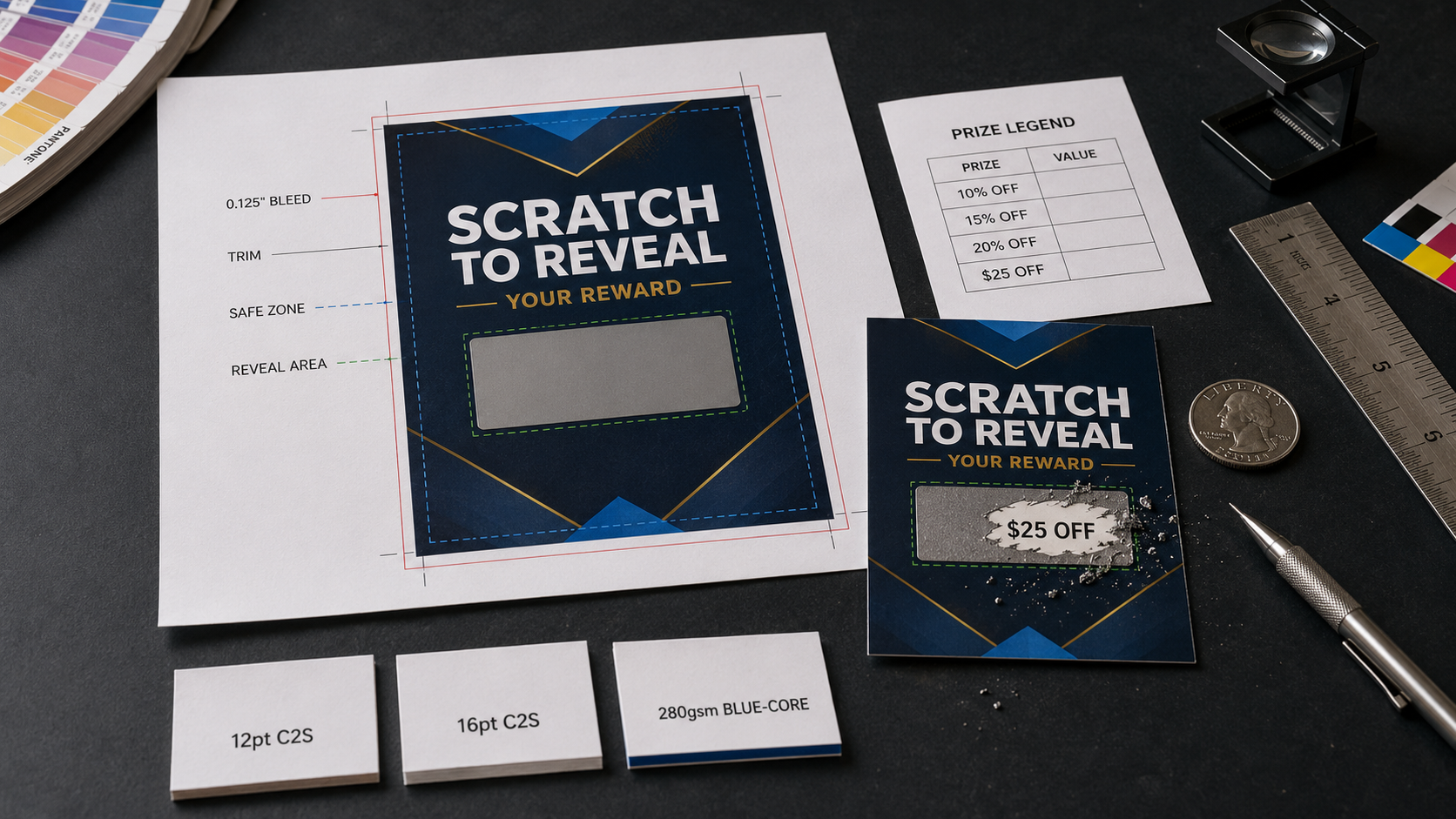
What are the standard sizes and trims?
Five options across both reveal families:
| Size | Trim | Common use |
|---|---|---|
| Mini | 2" x 3.5" | Business-card handouts, high-volume drops |
| Small | 2.75" x 4" | Receipts, loyalty, event cards |
| Medium | 4" x 6" | Direct mail at USPS postcard trim |
| Large | 6" x 9" | Premium mailers and fundraiser pieces |
| Custom | 2" x 2" up to 8.5" x 11" | Non-standard trims and die-cut shapes |
Custom trims and die shapes are set up through the custom size options and carry a one-time die charge. Standard rectangles do not.
What bleed and safe zone do you need?
Set bleed at 0.125 in on all four sides. Keep type, logos, and anything you cannot afford to lose back from the trim inside the safe zone. Trims are held to production tolerance, so a headline that sits right against the edge on screen can end up uneven across a run. This is the single most common fix we make on customer-supplied files.
Where should the reveal area go?
Treat the reveal area as a design element with its own footprint, not as an afterthought stamped on top:
- Keep it clear of the trim edge so the scratch layer has a clean margin.
- Never place it over a face, a logo, or the piece's headline.
- Size it to the content. A mini card typically carries a reveal around 1" x 0.6"; a medium card supports something closer to 2" x 1.5".
- Give the person a place to start. A visible, defined shape scratches more cleanly than a vague field.
How should the prize legend be laid out?
As a table, on the back, in type you can read without squinting. Include every tier and its value, the redemption window, and the conditions. The most common mistake is listing only the exciting tiers, which sets up an argument at the counter when someone reveals the common one. List them all.
What must appear on the card legally?
You supply the disclaimer, prize legend, and any odds or no-purchase-necessary language your counsel requires, and we print exactly what you approve. We do not draft legal copy. Two structural rules apply to every job we print:
- Nobody may buy a scratch off card, and nobody may pay for a chance at a prize. That would make the piece a lottery.
- Charitable programs use scratch and donate: the card is free, the donation is voluntary. See nonprofits and fundraisers.
What should you send us, and in what format?
Send print-ready files with bleed included, fonts outlined or supplied, and images at print resolution. Also send:
- The trim size and quantity you want quoted
- A marked position for the reveal area, or a note asking us to place it
- The prize legend copy and any required disclaimer text
- Logos in vector format where possible
If you have brand direction but no file, send copy and logos and our team will build the layout. Custom design work beyond layout is $125 per hour.
How does proofing work?
Digital proofs are free, and in most cases we return them the same day. Check four things before you approve: the reveal position, the legend copy, the spelling of every name and offer, and the trim size. Approval starts the clock, and standard production is 7 to 10 business days from that point. Rush production of 3 to 5 business days is available when the press schedule allows.
Which stock should the design assume?
Standard is 12pt C2S, which suits mailers, handouts, and receipt drops. Choose heavier or more opaque when the design calls for it:
- 14pt and 16pt for keepsakes, premium leave-behinds, and cards that live in a pocket for weeks
- 280gsm blue-core security stock when the reveal must not be readable through the card
Compare all options on cardstock weights. If dense artwork must sit on the reverse of the reveal, plan for the security stock during design rather than after the first proof.
How does the reveal style change the artwork?
A Classic silver or gold reveal only needs high-contrast content beneath it, usually type: see classic silver latex ink. A full-color reveal needs a real piece of art underneath, built to the reveal footprint, and costs more per card than Classic. Custom scratch layer colors are handled through custom color scratch ink.
What about perforations, stubs, and shapes?
Tear-away stubs, perforated entry sections, and die-cut outlines are all available, and they change the layout math because the stub needs its own margins and copy. Start with die cutting and perforations, then build the file around the finished shape rather than adapting a rectangle after the fact.
What is the fastest way to get real numbers?
Use the instant quote tool with your size, quantity, reveal style, and back printing. Quotes return within one business day, there are no setup fees on standard orders, and current per-card tiers are published on the pricing page.
Related guides
Share your artwork or use our Design-It-Yourself tools. We proof every job before printing. Orders ship in 7-10 business days.