
Scratch Off Direct Mail That Gets Opened
Why scratch off direct mail outperforms a plain coupon: postcard sizes and USPS rates, offer design, tracking codes, print specs, and per-card pricing.
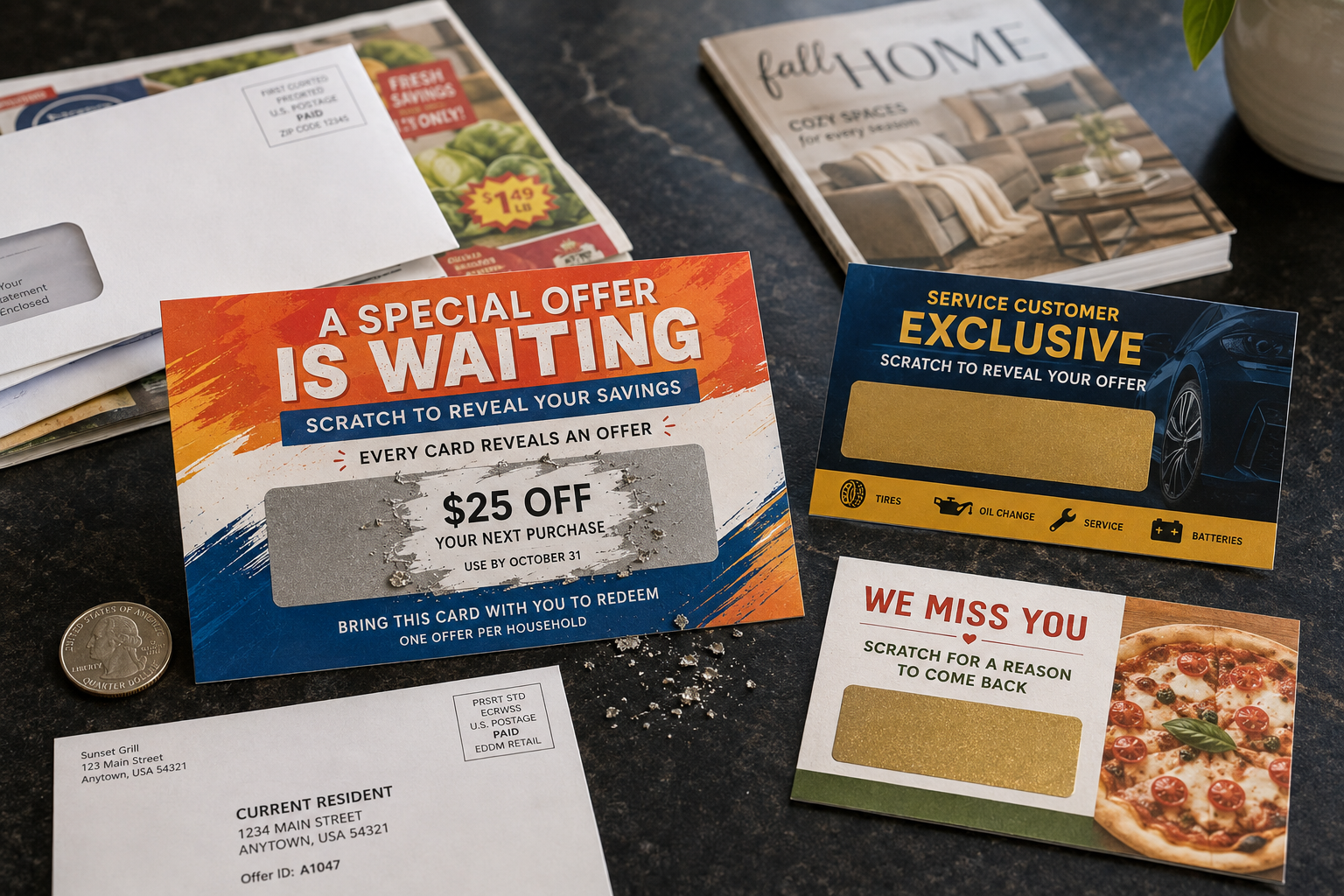
Which size mails at the best rate?
The 4" x 6" medium classic card is the standard USPS First-Class postcard trim, which keeps postage at the postcard rate instead of the letter rate. That single choice usually saves more money than any print decision on the job. If the piece needs to dominate the mailbox, the 6" x 9" large classic is the step up, at flat or letter postage.
| Size | Trim | Postage note |
|---|---|---|
| Small | 2.75" x 4" | Fits a #10 envelope for letter mail |
| Medium | 4" x 6" | USPS First-Class postcard trim |
| Large | 6" x 9" | Maximum presence, higher postage |
| Custom | 2" x 2" to 8.5" x 11" | Confirm mailability before die design |
How should the offer be structured?
Three rules that hold across industries:
- Every reveal resolves. List each tier and its value in a legend on the back, including the common tier most people will land on.
- Make the reward require a return trip. Redemption on a future visit is what turns spend into a second transaction.
- Set an expiration. A 30 to 60 day window creates the deadline that gets the card off the refrigerator.
Can you sell scratch off mailers or charge for entries?
No. Nobody may buy a scratch off card or pay for a chance at a prize, because that turns the campaign into a lottery. Mailed scratch off cards are giveaways. If the campaign is charitable, use the scratch and donate model described on the nonprofits and fundraisers page. You supply the disclaimer and prize-legend language and we print exactly what you approve.
How do you keep the reveal from being read through the card?
Two answers. First, design matters: keep dark solids and dense type off the reverse side directly behind the reveal area. Second, stock matters: the 280gsm blue-core security stock has an opaque core specifically so a bright light does not expose what is underneath. Options are on the cardstock weights page. Standard mailed cards print on 12pt C2S, which handles the mail stream well.
What are the artwork requirements?
Set bleed at 0.125 in on all sides, keep type and logos inside the safe zone away from the trim, and leave the reveal area clear of critical artwork. Our in-house team lays this out at no charge when you send copy, logos, and direction. Custom design work beyond layout is $125 per hour, and a custom die-cut shape carries a one-time die charge.
Classic silver or a full-color reveal?
For direct mail at volume, Classic silver or gold is almost always the right call: it reads as a scratch off from arm's length and keeps the per-piece cost low across thousands of records. A full-color reveal earns its higher per-card price when the payoff needs to be a photo or a product shot rather than a line of text.
How do you track redemption?
Print a unique code per list segment and log it at the point of redemption. Because the offer physically travels with the card, attribution is cleaner than an email campaign competing against every other message in an inbox. Variable data lets each segment carry its own code and its own offer without a separate press run. For a format comparison, see scratch off cards versus QR code mailers and scratch off cards versus coupon postcards.
What does a mail run cost per piece?
At 250 cards, the smallest online order, medium classic starts at $495, about $1.98 each. Across the catalog, per-card pricing runs from $0.08 on high-volume mini runs to $3.06 on low-quantity large full-color jobs. There are no setup fees on standard orders. Get exact numbers from the instant quote tool, which returns pricing within one business day.
How many records should you mail at once?
Mail the whole segment, then check the next price tier before you commit. Splitting a 2,000-piece list into four 500-piece drops costs more per card and dilutes the offer's momentum. If you need drops spread over time, print once and release by segment.
What is the schedule from artwork to mailbox?
Standard production is 7 to 10 business days after proof approval, with 3 to 5 day rush available when the press schedule allows. Free digital proofs usually come back the same day. Add mail house processing and USPS transit, then work backward from the date you want the offer live, not from the date you want to drop.
Which industries mail these most?
Restaurants and QSR, auto dealers and service, real estate, retail, and salons. Each has a version of the same job: get a customer who already knows the brand to come back inside a set window. Industry-specific guidance sits on the industries pages.
Related guides
Share your artwork or use our Design-It-Yourself tools. We proof every job before printing. Orders ship in 7-10 business days.